Maximum Volume of Annular Creatures
Published:
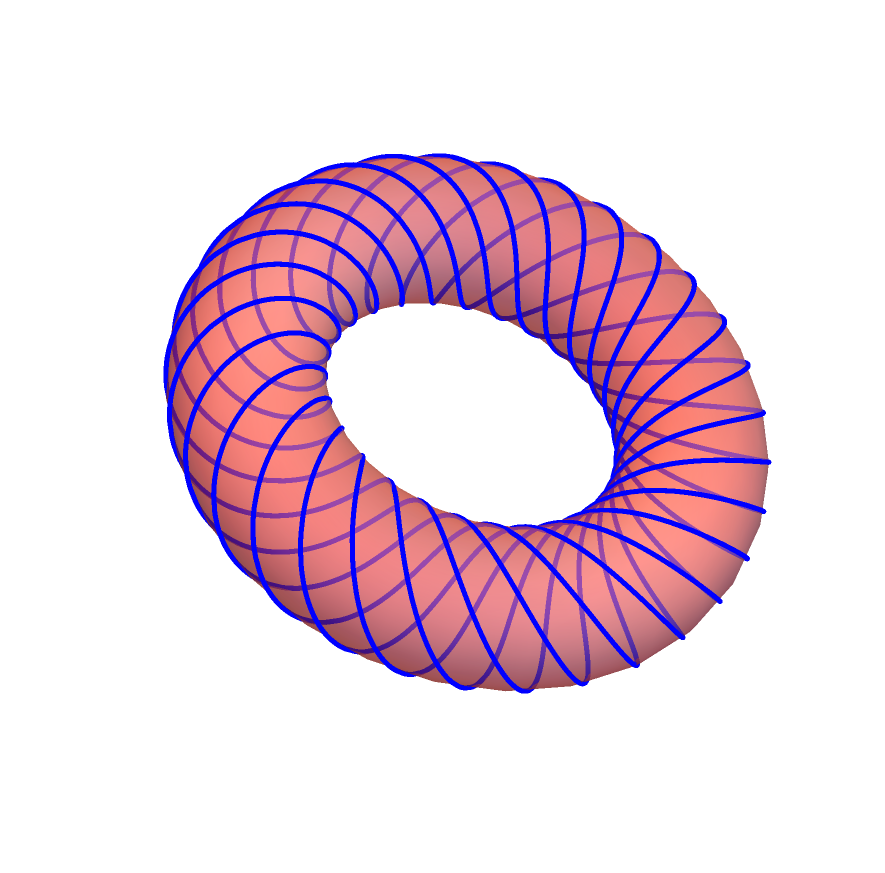
Assuming fibers are helically wound around a torus, given a fixed muscle fiber length, what should the helical winding angle be to maximize volume?
Maximum volume of a cylinder wound with helical fibers
Assuming a nematode consists of muscle fibers helically wound around a cylinder, given a fixed muscle fiber length, what should the helical winding angle be to maximize volume?
See J. B. Cowey (J Cell Sci* (1952) s3-93 (21): 1–15.).
\[V=\pi R^2*L=\frac{1}{4\pi} D^3 \sin^2\theta \cos\theta\]The volume is maximized when $\cos\theta=\frac{1}{\sqrt{3}}$.
Maximum volume of a fiber-reinforced torus
Assuming the fiber winds $k$ times, the parametric equation of the fiber can be written as:
\[p(\theta)=\{\cos\theta (R-r \cos k\theta),\sin \theta (R-r \cos k\theta ),r \sin k\theta \}\]The fiber length can be written as:
\[ds=\sqrt{k^2r^2+(R-r\cos k\theta)^2}d\theta\]For a fixed fiber length:
\[\int_0^{2\pi}\sqrt{k^2r^2+(R-r\cos k\theta)^2}d\theta=L\]The volume of the torus is:
\[V=2\pi^2r^2R\]The problem reduces to maximizing the volume when the fiber length $L$ and the number of turns $k$ are fixed. Non-dimensionalizing length by $L$ and volume by $2\pi^2L^3$, the problem becomes:
\[\int_0^{2\pi}\sqrt{k^2r^2+(R-r\cos k\theta)^2}d\theta=1, k=1,2,3......N\] \[V=r^2R|_{max}, \ \ \ \ \ \ \ \ \ \ \ \ \ \ \{r,R\}\]Let $\Lambda$ be the Lagrange multiplier:
\[\begin{aligned} \mathcal{L}=r^2R-\Lambda(\int_0^{2\pi}\sqrt{k^2r^2+(R-r\cos k\theta)^2}d\theta-1)\\ Variables:\{r,R,\Lambda \} \end{aligned}\]Taking partial derivatives:
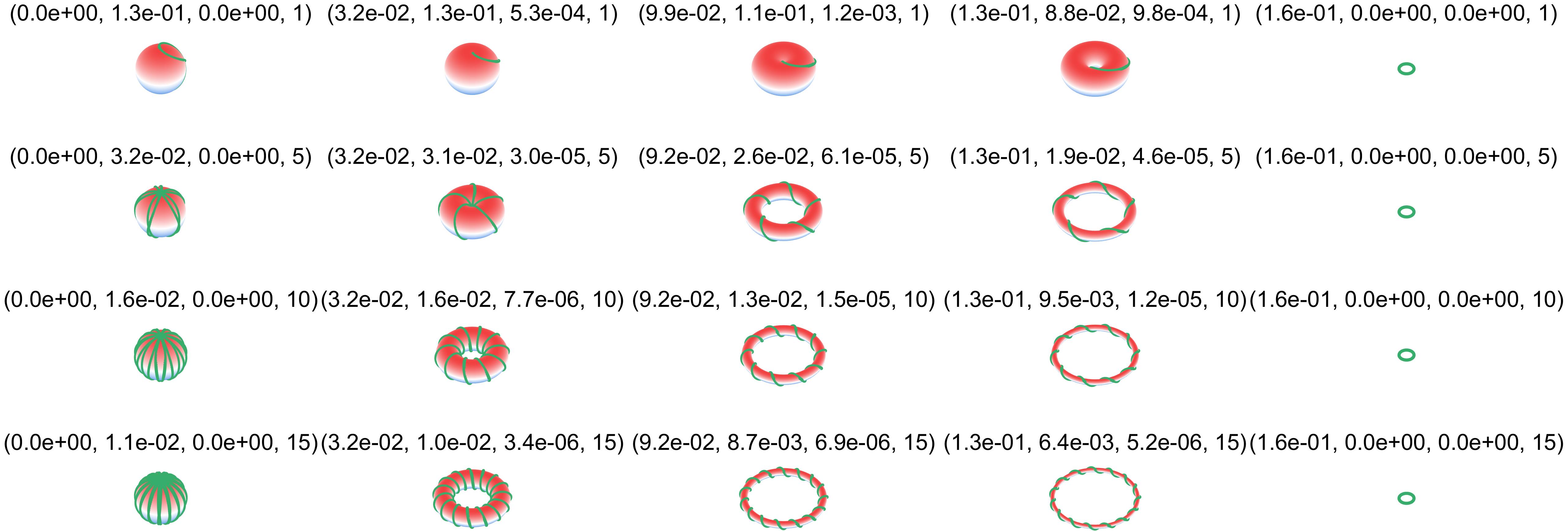
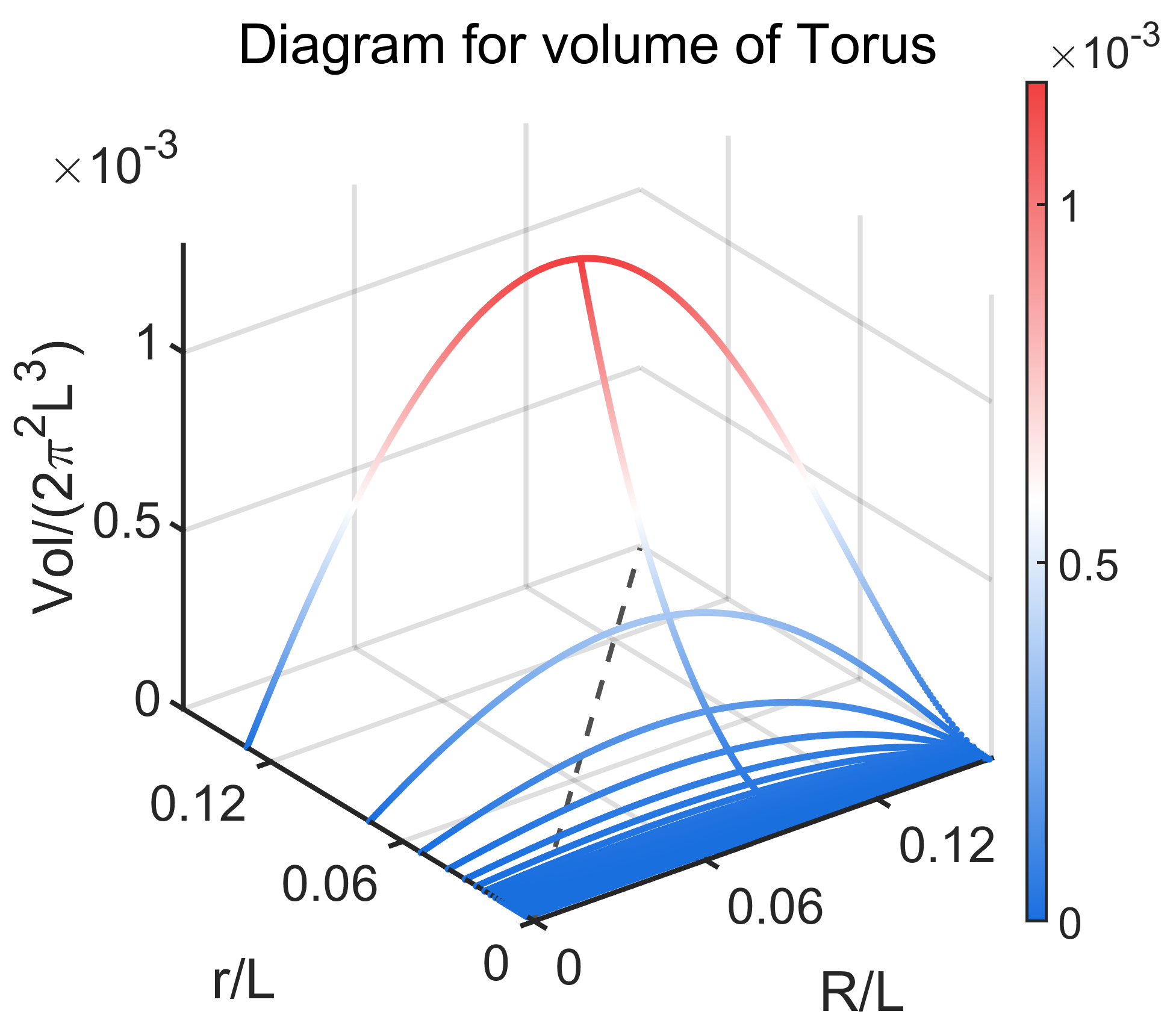
\[\begin{aligned} \frac{\partial \mathcal{L}}{\partial \Lambda}=\int_0^{2\pi}{\sqrt{k^2r^2+(R-r\cos k\theta )^2}}d\theta -1=0 \\ \frac{\partial \mathcal{L}}{\partial r}=2rR-\Lambda \int_0^{2\pi}{\frac{k^2r+kr\cos ^2\theta -R\cos \theta k}{\sqrt{k^2r^2+(R-r\cos k\theta )^2}}}d\theta =0 \\ \frac{\partial \mathcal{L}}{\partial R}=r^2-\Lambda \int_0^{2\pi}{\frac{R-r\cos \theta k}{\sqrt{k^2r^2+(R-r\cos k\theta )^2}}}d\theta =0 \end{aligned}\]Solving Eq. (8) numerically yields the optimal torus values, as shown in the figure below:
Torus configurations for different winding numbers, with annotations in the form $(R/L, r/L, Vol/L^3)$: